
Sourcing questions always arrive in the same order: how many do I have to buy, how long does it take, and can it legally be sold in my market. These three answers decide whether a private label dog training collar program is viable for your brand, and they are the questions most suppliers answer vaguely.
This guide gives you the numbers you can plan around — MOQ and what it includes, realistic sampling and production timelines, and a clear line between the certificates a factory holds and the ones your brand registers — plus the shipping terms and the difference between an OEM and an ODM program.
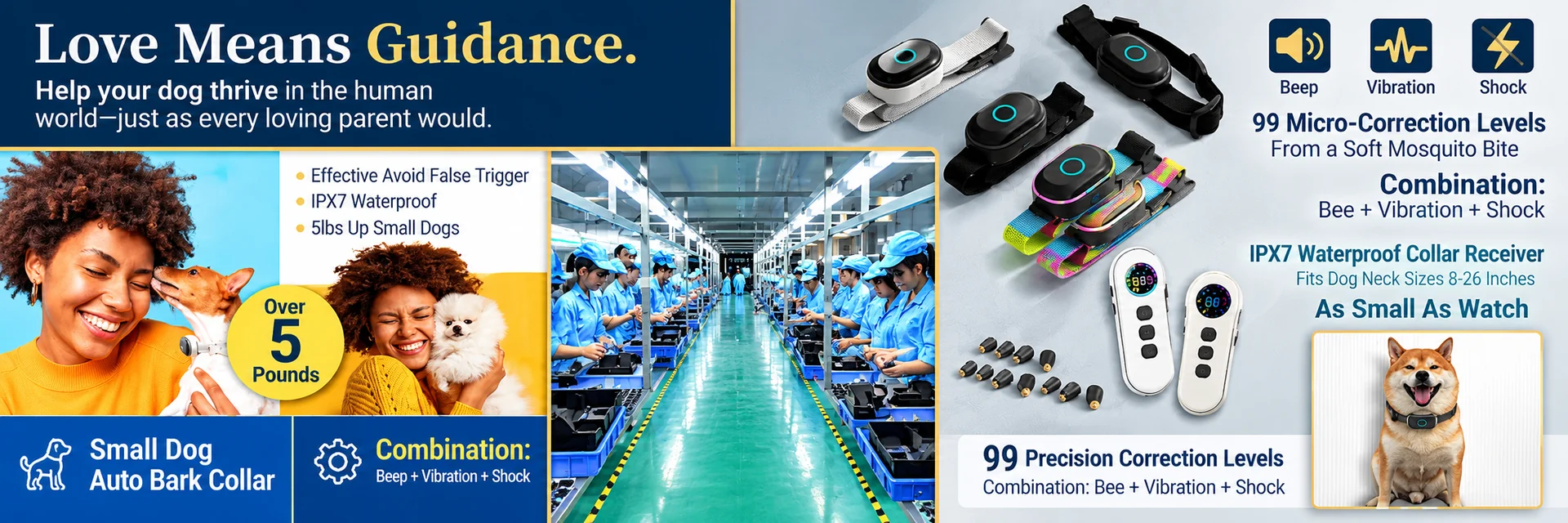
MOQ: what 300 pcs per SKU actually covers
For OEM orders the standard minimum is 300 pieces per SKU. That number is only meaningful once you know what is inside it, and a good supplier will itemise it:
- Logo silk-screen printing on the transmitter and receiver
- Custom collar strap colour and material (TPU or nylon)
- Custom colour-box packaging and printed user manual
- Contact points, test light and charging cable as standard inclusions
Mixing colours within one model is possible when shell materials are already in stock. Because stock moves weekly, treat mixed-colour orders as something to confirm at the time of ordering rather than an assumption carried across seasons.
If you want to evaluate quality before committing, ask for neutral samples. They are unbranded, ready to ship, and carry no MOQ — the fastest way to put a collar on a real dog and see how it behaves.
Lead time: one day for samples, 25–30 days for bulk
- Neutral samples: dispatched in about one business day
- Customised pre-production samples: typically 3–7 business days
- Bulk production: 25–30 days after sample approval and deposit
That bulk window is stable because the supply chain is short: R&D, injection moulding, assembly and packing all happen in one 2,000 m² facility with four production lines. What delays an order in practice is late artwork or unresolved packaging approval, not production capacity. If you want a date you can plan a launch around, lock packaging artwork before you approve the sample.
Certification: what is held, and what is registered
This is where buyers get confused, and it is worth separating three distinct things.
Factory certification covers how the plant is run — ISO 9001 quality management. Product compliance covers the destination market — CE and RoHS for the EU. Test reports are the evidence behind the claims: a 1.2 m drop test, an IPX7 waterproof rating test, UN38.3 and MSDS for the lithium battery.
Radio and market-specific approvals — FCC for the US, IC/ISED for Canada, RCM for Australia — are registered under the brand owner’s name. No factory can hold them for you. What a capable OEM partner does is supply the test data, technical files and samples so your registration goes through without paying for a second round of testing.
Ask directly which certificates a supplier holds and which they can only support. The precision of that answer tells you more about them than any catalogue.
OEM or ODM: which one do you need
OEM takes an existing platform and makes it yours: logo, colours, strap, packaging, manual. It is fast, low risk, works at a 300-piece MOQ, and is the right choice for a first launch or a new market test.
ODM develops new hardware or firmware — a different enclosure, a new display, a custom function. It needs engineering time, tooling and a higher volume commitment, and it is the right choice once you have volume and want a product nobody else can list. If you are unsure, launch OEM, learn what sells, then move the winning SKU to ODM.
Shipping terms and freight
Standard terms are FOB Shenzhen, FOB Hong Kong and EXW, with express and bulk freight handled through DHL, FedEx and UPS. For samples, express courier beats waiting to consolidate — a week of testing time is worth more than the freight saving.
A practical first order
A low-risk sequence: order neutral samples in both categories, evaluate fit, sensor behaviour, range and build quality, then place a 300-piece OEM order on the model that performed best — with either custom packaging or a mixed colour assortment. Approve the pre-production sample, then allow 25–30 days for the bulk run.
Frequently asked questions
What is a realistic MOQ for private label dog training collars?
300 pcs per SKU is the standard minimum for OEM orders, and it normally includes logo silk-screen printing, custom strap colour and material, custom colour-box packaging and a printed user manual. Mixed colour assortments within one model can be arranged when shell materials are in stock, but stock moves — confirm at the time of order. Neutral unbranded samples carry no MOQ and ship from stock.
How long does it take from sample approval to delivery?
Neutral samples are dispatched in about one business day, customised pre-production samples typically take 3–7 business days, and bulk production runs 25–30 days after sample approval and deposit. In practice the bottleneck is artwork and packaging approval on the brand side, not factory capacity.
Which certifications does the factory hold, and which do I register myself?
A manufacturer should hold ISO 9001 for its quality system and CE and RoHS compliance for the product, plus UN38.3 and MSDS for the battery and IPX7 plus 1.2 m drop test reports. FCC (US), IC/ISED (Canada) and RCM (Australia) are registered under your brand name. Be cautious with any supplier that claims to hold these for you.
What is the difference between OEM and ODM for training collars?
OEM takes an existing proven platform and makes it yours — logo, colours, strap, packaging and manual — with a 300-piece MOQ and a short timeline. ODM develops new hardware or firmware: a different enclosure, display or function set. ODM requires engineering time, tooling and a higher volume commitment, and is the right move once you have volume and want a product no one else lists.
About StarNavi
StarNavi is a Shenzhen manufacturer that produces nothing but electronic dog training and bark control collars. We run a 2,000 m² ISO 9001 facility with 4 production lines, 2 in-house ID designers and 3 engineers, and a monthly capacity of 120,000 units — up to 200,000 at full output. Our CTO has spent 18 years in this product category, part of the first generation of engineers who built e-collars in China, and every stage from R&D and tooling to assembly and shipment happens under one roof.
Today we supply OEM and ODM programs for pet brands across more than 10 countries in Europe, North America, Korea and Japan, covering custom logo printing, strap materials and colours, retail packaging and user manuals, through to entirely new product development. Standard MOQ is 300 pcs per SKU; neutral samples ship in one day and bulk production runs 25–30 days. Contact us to request samples and a detailed quote.
Related guides
Related guides: Remote Training Collar vs Auto Bark Collar: Which OEM SKU Should Your Brand Launch First? · How to Vet a Dog Training Collar Manufacturer: 8 Questions to Ask
Explore our products
Explore our products: Private Label OEM/ODM Small Dog Remote Training Collar (Model: DB900X) · Private Label OEM/ODM Auto Bark Collar 7 Modes (Model: DB300A)